

3 min read
Atlantic Sea Salt: From the Wild Irish Coast
How the mineral-rich waters of the Atlantic west coast become a key ingredient — and why sea salt has been prized for centuries.
Where the Land Gives Way to the Atlantic
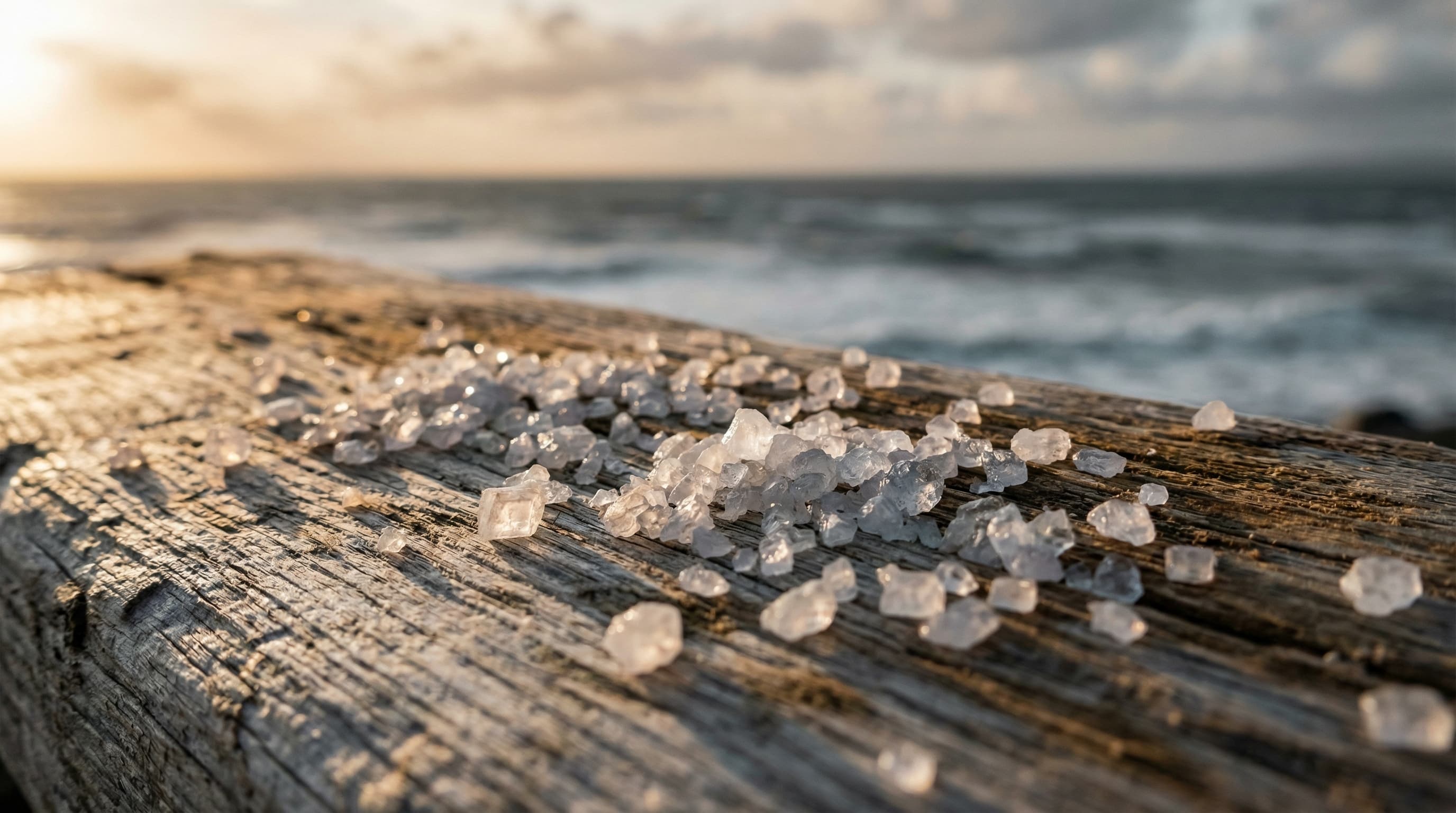
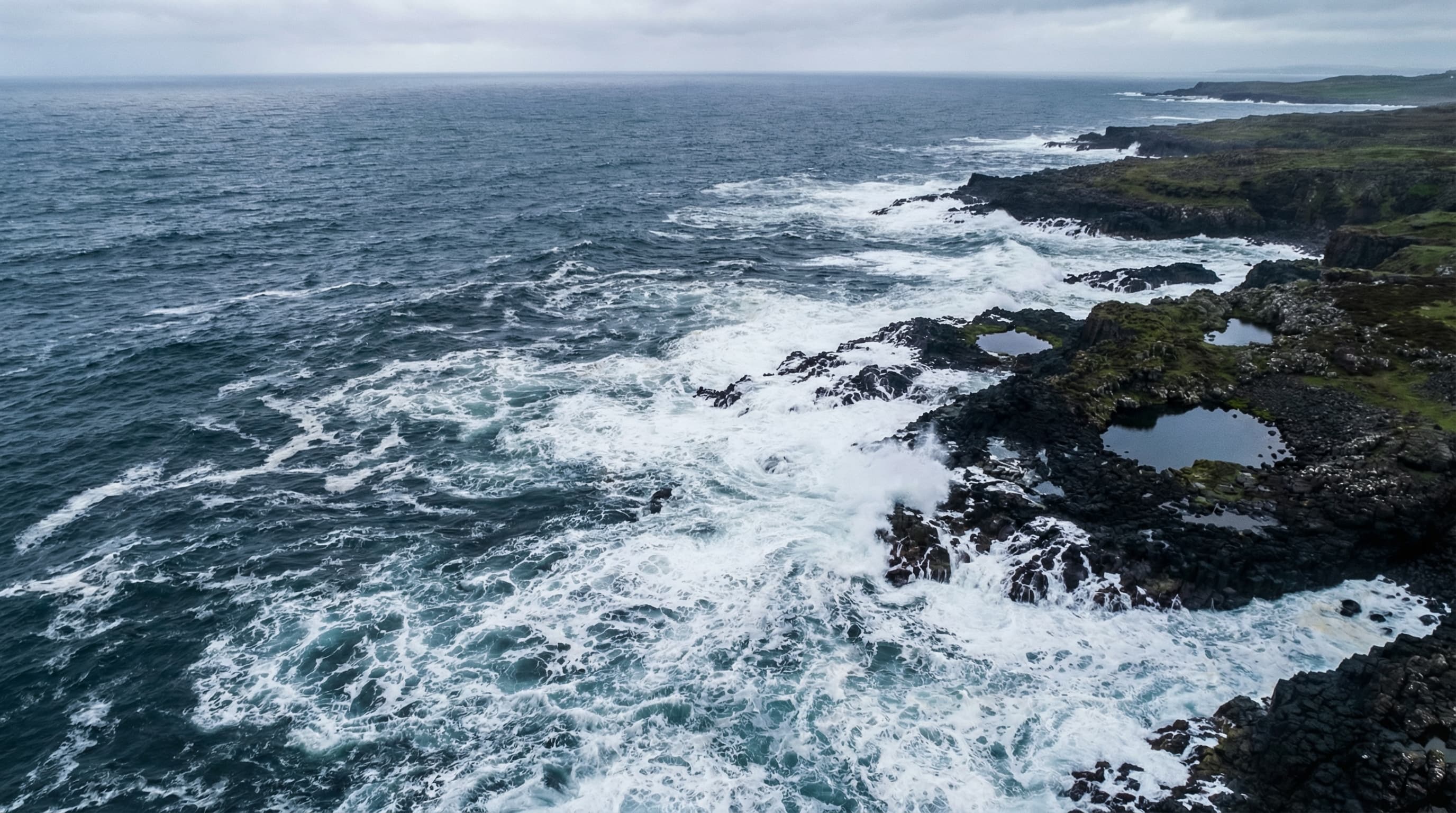
There is a stretch of the Irish west coast where the cliffs fall away in great dark folds of rock, and the Atlantic arrives with a force that feels almost personal. The water here is not calm. It is not decorative. It churns against stone that has held its ground for three hundred million years, sending white plumes skyward, leaving behind a fine crystalline residue that catches the light like scattered glass. This is where Ireland meets the open ocean — where the Gulf Stream carries warmth from distant tropics and the prevailing westerlies drive salt spray deep inland, coating the hedgerows and the lichen-covered walls of abandoned cottages. The air itself tastes of the sea. Stand on the Burren coastline in a February gale and you will feel it on your lips, in your lungs, settling on the backs of your hands like a second skin. It is from these waters — cold, mineral-dense, perpetually in motion — that Atlantic sea salt has been gathered for as long as people have lived along this coast.
An Ancient Practice, Quietly Enduring
The harvesting of sea salt in Ireland is not a modern enterprise dressed in artisanal clothing. It is genuinely old. Archaeological evidence places salt production along the Irish coast as far back as the Bronze Age, when shallow clay-lined pans were used to evaporate seawater over peat fires. The practice continued through the medieval period, when salt was among the most valuable commodities in trade — a preservative, a currency, a substance considered almost sacred. Monastic communities along the western seaboard maintained salt works well into the seventeenth century. For these early producers, the method was simple and slow: seawater was collected in stone pools during high tide, then left to the wind and the weak Irish sun. What remained after days of patient evaporation was a coarse, grey-white salt, rich with the trace minerals of its origin. The practice nearly vanished during the industrial era, when mined rock salt and vacuum-refined table salt made coastal production uneconomical. But in recent decades, a quiet revival has taken hold. Small-batch producers along the Clare, Galway, and Kerry coasts have returned to traditional methods — or thoughtful adaptations of them — drawing on the same waters their ancestors knew.
The sea does not give up its salt easily. It asks for patience, for wind, for the slow alchemy of evaporation — and what it leaves behind carries the memory of the whole Atlantic.
What the Water Leaves Behind
Atlantic sea salt is not sodium chloride alone. The waters off the west coast of Ireland carry a complex mineral signature shaped by ocean currents, depth, temperature, and the geology of the seabed. When this water is carefully evaporated, what crystallises is a salt containing meaningful concentrations of magnesium, potassium, calcium, and dozens of trace elements. Each of these minerals plays a distinct role when applied to the skin. Magnesium supports the skin's natural barrier function and helps to calm inflammation — it is the mineral most associated with the soothing quality of a sea swim. Potassium assists in maintaining proper moisture balance, helping skin cells retain the hydration they need without becoming congested. Calcium supports cell turnover, the quiet process by which the skin continually renews itself from within. Together, these minerals create something greater than the sum of their parts. Unlike refined salts, which are stripped down to pure sodium chloride through industrial processing, Atlantic sea salt retains its full mineral complexity. It is this completeness — this faithfulness to its source — that makes it so effective as a skincare ingredient.
From Coast to Craft
At Celtic Dawn, Atlantic sea salt is not a novelty ingredient. It is foundational. We use it for its dual capacity: as a gentle physical exfoliant and as a vehicle for mineral nourishment. The crystals we source are coarse enough to provide meaningful texture — the kind that lifts away dead skin cells and encourages circulation when worked across the surface — but not so aggressive as to damage or irritate. This is an important distinction. Many commercial exfoliants rely on uniformly sharp particles or synthetic microbeads that create microscopic tears in the skin. Atlantic sea salt, with its naturally irregular crystal structure, offers something different: effective exfoliation that works with the skin rather than against it. Beyond the physical action, there is the mineral infusion. As the salt dissolves against warm, damp skin, it releases its cargo of magnesium, potassium, and calcium directly into the uppermost layers of the epidermis. The skin does not merely feel smoother after use — it is genuinely nourished, its mineral balance subtly restored. We combine Atlantic sea salt with grass-fed tallow and botanical oils, allowing the minerals to be carried deeper by these lipid-rich bases. The result is a formulation where exfoliation and moisturisation happen in a single gesture — no need for a separate serum or lotion to compensate for what a harsh scrub has stripped away.
This is not generic salt from an industrial evaporation plant. It is a specific substance from a specific place — shaped by the same winds and currents that have defined the Irish coast for millennia.
The Argument for Place
In an industry saturated with ingredients sourced from wherever they are cheapest and processed into indistinguishable uniformity, there is something worth defending in the idea of provenance. Atlantic sea salt from the west coast of Ireland is not interchangeable with Dead Sea salt, Himalayan pink salt, or French fleur de sel. Each carries the signature of its origin — its particular mineral ratio, its crystal habit, its texture and colour. The salt we use carries the character of the Atlantic: its relentless energy, its mineral generosity, its rawness. It connects each product back to a real place — not a supply chain abstraction, but a coastline you could walk, a body of water you could stand beside and feel. This matters not because provenance is a marketing device, but because skincare is ultimately an act of contact between your body and the natural world. The closer that contact remains to something genuine and undiminished, the more honestly it can do its work. The Atlantic has been shaping the Irish coast for longer than anyone can reckon. The salt it leaves behind is a small, crystalline record of that process — and when it meets your skin, something of that wild origin travels with it.