

4 min read
Why We Choose Cold-Process Soapmaking
Mass production is faster. But cold-process preserves the full potency of every botanical ingredient. Here is why we will never take the shortcut.
A Quiet Act of Chemistry
There is a moment in every batch when the oils and lye first meet — a gentle swirl of amber and white that slowly thickens into something new. No furnaces. No industrial vats. Just a careful blending of plant oils, sodium hydroxide, and water at temperatures barely above room warmth. This is cold-process soapmaking, and it is one of the oldest methods of transforming fat into cleanser. The principle has not changed in centuries: oils and alkali undergo saponification, a chemical reaction that produces soap and glycerin. What has changed is the world around it — an industry that decided patience was too expensive, that heat and shortcuts and synthetic detergents were good enough. We decided otherwise.
What Heat Takes Away
Most commercial soap is not soap at all. It is a syndet bar — a compressed block of synthetic detergents, petroleum derivatives, and artificial fragrance designed to lather quickly and cost little. Even those that begin with real oils often rely on the hot-process method or industrial continuous processing, where temperatures climb above 80°C to accelerate the reaction. Speed comes at a cost. Heat degrades the delicate volatile compounds in botanicals — the very terpenes, phenols, and antioxidants that make lavender calming, rosemary invigorating, and chamomile gentle on inflamed skin. By the time a hot-processed bar reaches the shelf, its botanical story has been rewritten by temperature. Cold-process soapmaking holds the reaction below 40°C. At these temperatures, the essential oils, herbal infusions, and plant butters we fold into each batch retain their full aromatic and therapeutic character. The bar you unwrap smells the way the ingredient did when it was harvested — because nothing has burned it away.
We do not add botanicals for decoration. We protect them through every stage of the process so they can do what nature designed them to do.
The Glycerin That Others Discard
Saponification produces two things: soap and glycerin. Glycerin is a humectant — it draws moisture from the air and holds it against the skin. It is, by any measure, one of the most effective and gentle moisturising agents known. In large-scale manufacturing, the glycerin is extracted and sold separately, often to the cosmetics industry at a premium. The soap that remains is stripped of its natural emollient, which is why so many commercial bars leave skin feeling tight and dry. A cold-process bar keeps every molecule of glycerin exactly where it formed — distributed throughout the bar, inseparable from the soap itself. When you wash with a Celtic Dawn bar, the glycerin stays on your skin. That softness you feel after rinsing is not a coating or a chemical trick. It is the soap doing what soap was always meant to do before the industry decided to sell the best part separately.
Patience as an Ingredient
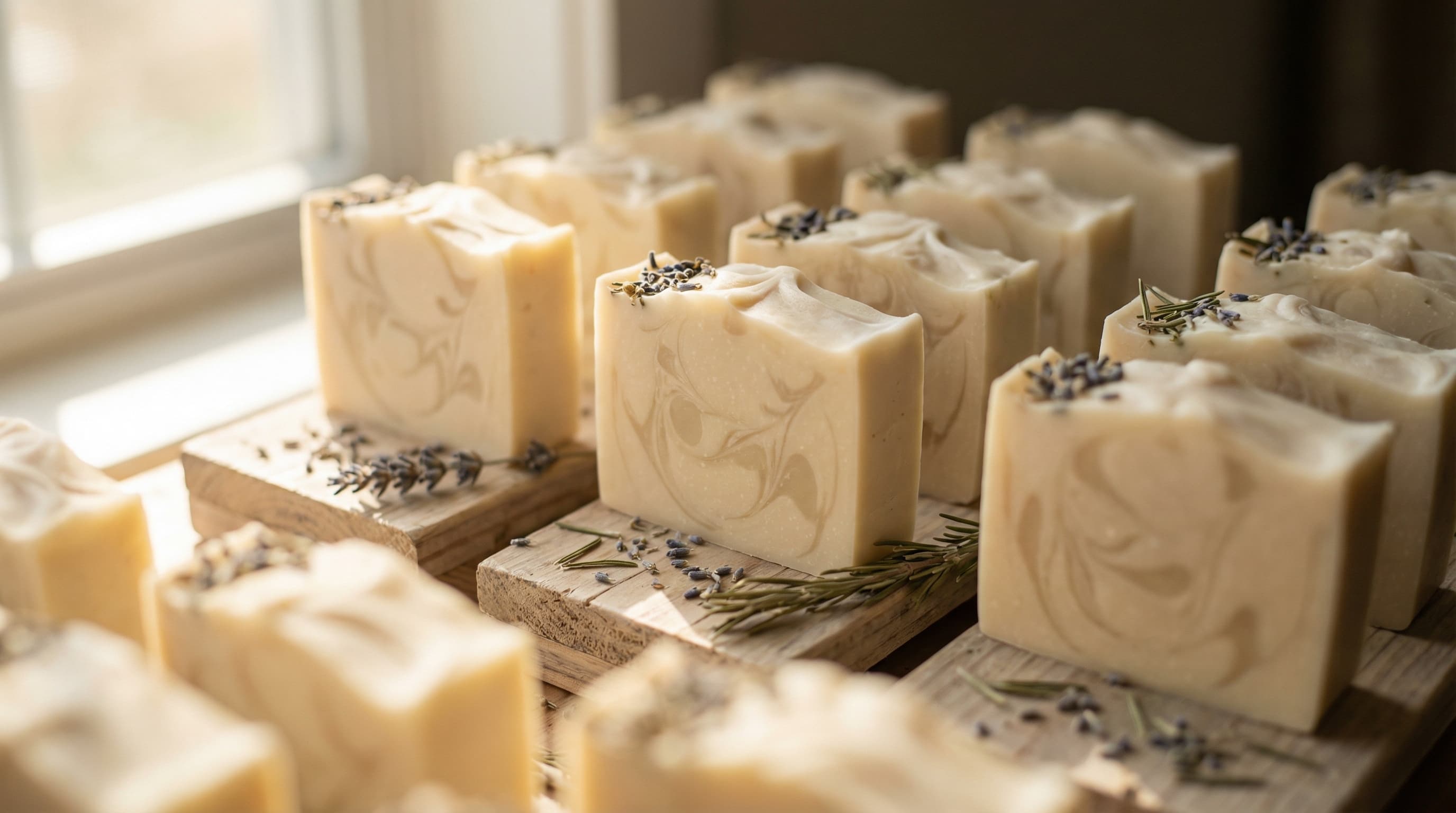
A cold-process bar cannot be used the day it is made. After unmoulding and cutting, each bar enters a curing period of four to six weeks. During this time, excess water evaporates, the crystal structure of the soap tightens, and the pH gradually lowers to a skin-friendly range. The bar becomes harder, longer-lasting, and milder. There is no way to rush this. You cannot add a chemical to accelerate evaporation without compromising the bar. You cannot seal it in plastic to ship sooner without trapping moisture that will soften and spoil it. You simply wait. In an industry built on quarterly targets and next-day delivery, this is a radical act. Every Celtic Dawn bar sits quietly on its curing rack for the full duration, turned by hand each week to ensure even drying. By the time it reaches you, it has had six weeks to become exactly what it should be.
Six weeks of patience is not a delay in our process. It is the process.
The Beauty of Imperfection
No two cold-process bars are identical. The swirl of colour where turmeric meets French green clay will never repeat. The surface might carry a faint ash bloom — a thin mineral veil caused by exposure to air during saponification — that some makers scrape away but we leave as a signature of authenticity. Slight variations in shade occur from batch to batch as the natural pigments in our botanicals shift with the seasons. A bar made with summer lavender will carry a different warmth than one made in October. These are not defects. They are proof that a human hand guided the pour, that real plants gave the colour, that no two batches of tallow rendered from grass-fed Irish cattle will ever be precisely alike. In a world saturated with machine-stamped uniformity, we find these variations beautiful. They are the opposite of mass production. They are the quiet evidence that someone cared enough to make this bar slowly, one at a time.
Small Batches, Full Attention
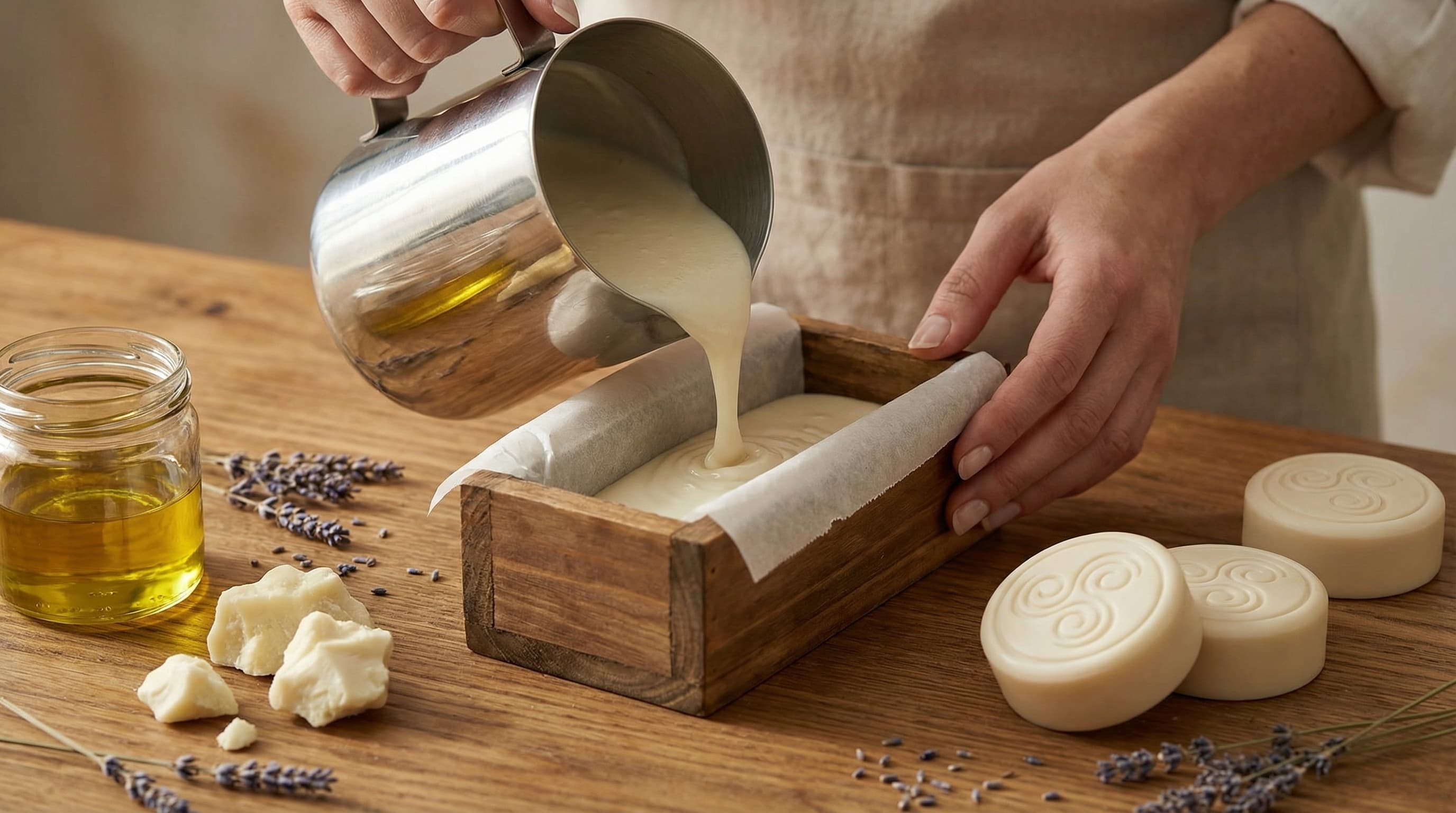
Every Celtic Dawn batch begins with the weighing of oils — Irish grass-fed tallow, coconut oil, olive oil — measured to the gram on a calibrated scale. The lye solution is prepared, cooled, and added in a thin stream while a stick blender brings the mixture to trace, that moment when the batter holds a faint line drawn across its surface. From there, botanicals are folded in by hand: dried herbs, essential oil blends, mineral clays. The batter is poured into wooden moulds lined with parchment, insulated with blankets, and left to saponify overnight. The next morning, the loaf is unmoulded and cut into individual bars with a wire cutter. Each one is inspected — checked for air pockets, uneven colour, or any sign that the batch did not behave as expected. Bars that do not meet our standard are set aside. They are still perfectly good soap, but they are not Celtic Dawn. This is not a process that scales gracefully. It requires presence, attention, and a willingness to discard work that does not meet the mark. But it is the only way we know to make something worth putting our name on — something that honours both the ingredients and the person who will eventually hold it in their hands.