5 min read
The Triskelion: 5,000 Years of Meaning
From Newgrange to Celtic Dawn — the story of the triple spiral, what it means, and why it became our symbol of renewal and intention.
Carved Before the Pyramids
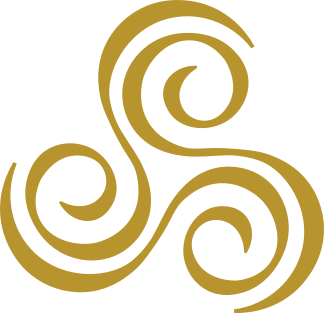
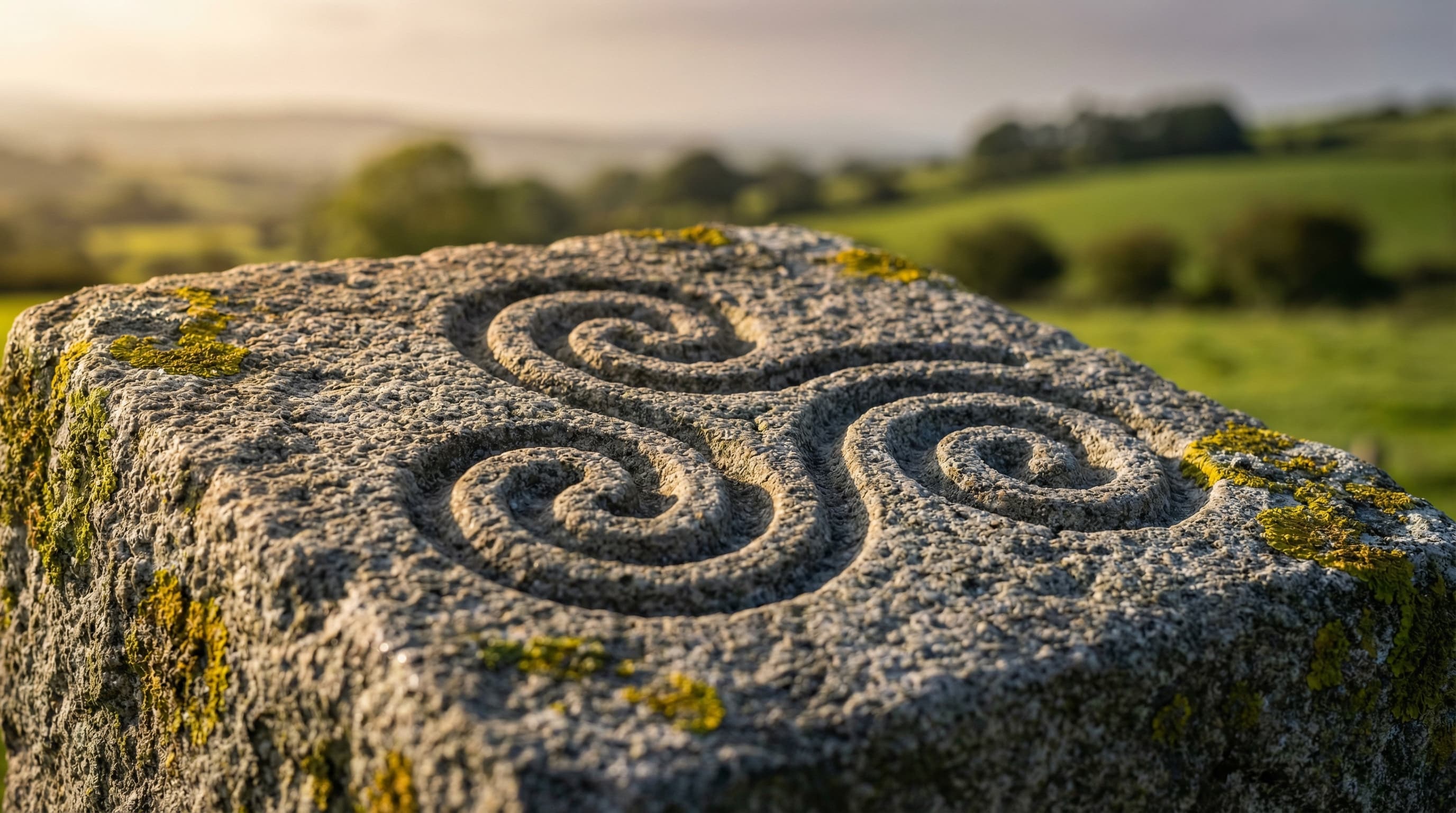
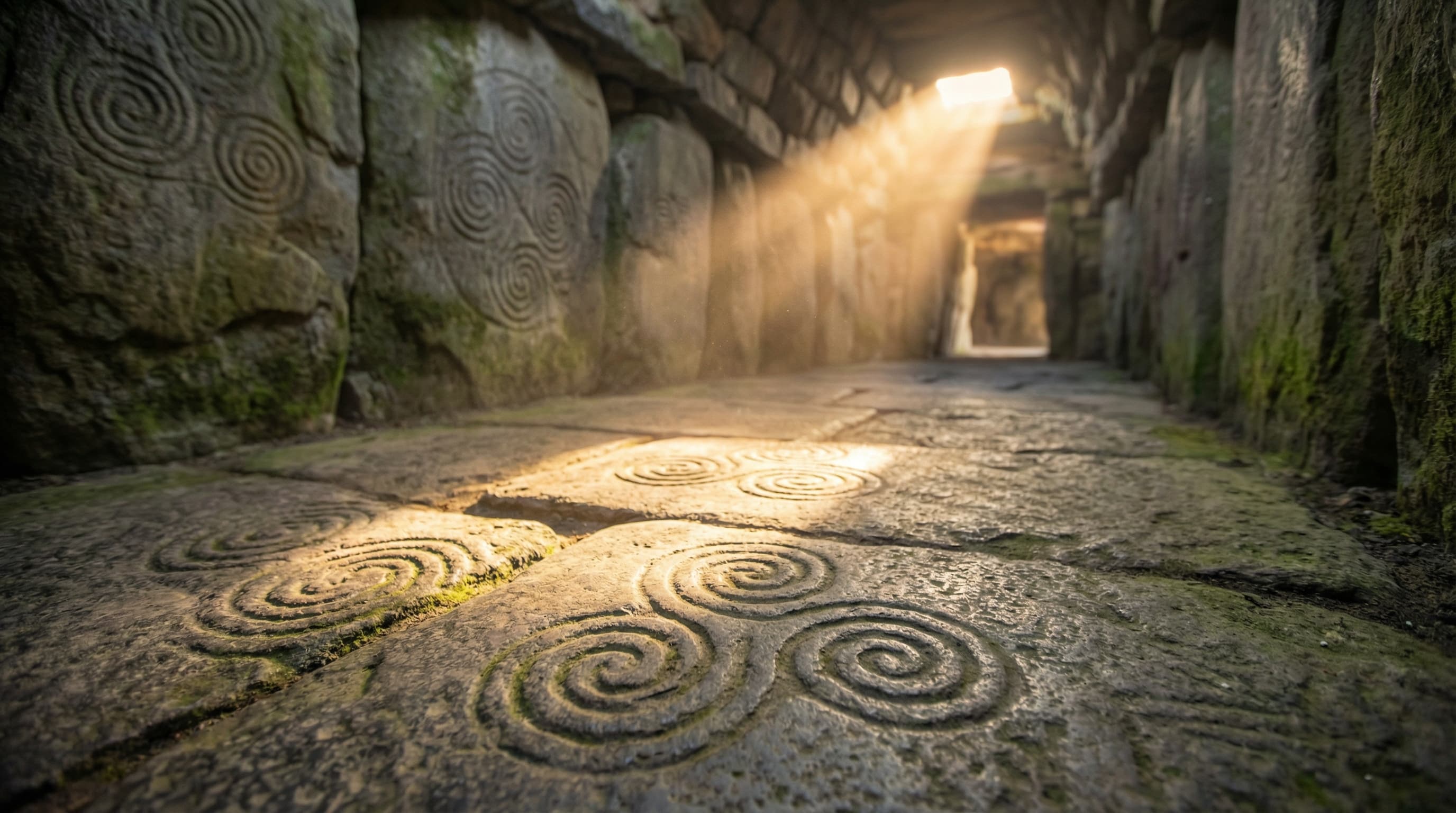
Long before the first stones of the Great Pyramid rose from the sands of Giza, a community of Neolithic farmers in the Boyne Valley of Ireland was building something extraordinary. Around 3200 BC — more than five thousand years ago — they raised Newgrange, a vast passage tomb aligned with the winter solstice. On the morning of the shortest day, a narrow beam of sunlight travels the length of the chamber and illuminates the innermost recess for exactly seventeen minutes. It is one of the oldest astronomical observations ever constructed, and it still works. But it is not the engineering that stops most visitors in their tracks. It is the entrance stone: a massive kerbstone covered in spiralling carvings, the most prominent of which is a triple spiral — three interlocking whorls that radiate outward from a shared centre. This is the triskelion, one of the oldest symbols in human history, and it has never been fully explained. No written record accompanies it. No Rosetta Stone bridges the gap between those who carved it and those of us who stand before it now, tracing its lines with our eyes, feeling that it means something we almost understand.
The triskelion asks nothing of you except attention. Stand before it long enough and you begin to feel the pull of its motion — always turning, never arriving, endlessly becoming.
Three Spirals, Many Meanings
What does the triple spiral represent? The honest answer is that no one alive can say with certainty what its Neolithic creators intended. But the symbol has gathered meaning like a river gathers tributaries, and each interpretation reflects something true about the Irish relationship with the natural world. Some scholars read it as the three realms of Celtic cosmology: land, sea, and sky — the foundations upon which all life depends. Others see the cycles of existence: birth, life, and death, or more gently, growth, rest, and restoration. Still others map it onto time itself: past, present, and future, spiralling outward from a single origin. In early Irish mythology, the triple spiral appears at thresholds and sacred sites, always marking a place where the ordinary world thins and something deeper shows through. What every interpretation shares is movement. The triskelion is not static. Its arms reach outward. Its curves suggest rotation, momentum, return. It is a symbol that breathes. And in a landscape shaped by Atlantic weather, by seasons that arrive with unmistakable force, that sense of rhythm and renewal would have been not poetry but plain observation. The land teaches you to move in cycles if you pay attention.
Surviving the Centuries
The remarkable thing about the triskelion is not just its age but its persistence. It survived the arrival of Celtic culture in Ireland during the Iron Age, where it found new expression in the elaborate knotwork and metalwork of La Tène art. It survived the coming of Christianity, when monks wove it into illuminated manuscripts alongside crosses and gospel text — most famously in the Book of Kells, where triple spirals appear in dizzying profusion, their pagan origins quietly absorbed into a new sacred context. It survived colonisation, famine, emigration, and revival. Today it appears on everything from jewellery to passports, from pub signs to the carved lintels of heritage centres. It has become, without anyone quite deciding it should, one of the defining symbols of Ireland itself. Not the harp, not the shamrock — those carry political and commercial weight. The triskelion carries something older and less easily co-opted: a sense of continuity with the deep past, a visual reminder that this island has been home to people who thought carefully about the world for a very long time.
Why Celtic Dawn Chose the Triple Spiral
When we set out to create Celtic Dawn, we knew the brand needed a symbol that could hold everything we believe about skincare — that it is not vanity but a form of attention, not a transaction but a ritual. We wanted something that spoke to Ireland without sentimentality, something ancient that still felt alive. The triskelion was the only real answer. Its three spirals mirror the structure of our collection: three soaps, each one an expression of a different relationship with the body. The Original, unscented and elemental, grounded in tallow and tradition. The Lavender, calming and restorative, made for the moments when you slow down. The Tea Tree, clarifying and purposeful, for mornings when you need to arrive fully in the day. Three products. Three intentions. Three turns of the spiral. More than that, the triskelion embodies the philosophy behind everything we make. Skincare is cyclical. Your skin renews itself roughly every twenty-eight days — a lunar cycle, a tidal rhythm. The best thing you can do for it is honour that process: cleanse, nourish, rest. Growth, care, restoration. The triple spiral is not a logo we designed. It is a pattern we recognised.
We did not design a symbol. We recognised one — a pattern already present in the way skin renews, seasons turn, and rituals take shape.
Ancient Wisdom, Living Practice
There is a tendency in modern wellness culture to treat ancient symbols as decorative — stripped of context, printed on tote bags, emptied of meaning. We have tried to do the opposite. The triskelion on our packaging is an invitation to think about what you are doing when you wash your face or hands. It is a reminder that this small act connects you to something larger: to the long human tradition of using what the land provides to care for the body, to the understanding that renewal is not something you buy but something you participate in. The people who carved the entrance stone at Newgrange understood cycles. They built an entire monument to mark the moment when darkness begins to recede and light returns. They knew that the world moves in spirals, not straight lines — that growth requires rest, that restoration follows release, that every ending curves back toward a beginning. Five thousand years later, standing in a bathroom in Dubai or Dublin, you run a bar of soap under warm water and begin. The spiral turns again.